martes, 19 de febrero de 2013

Medicina paliativa alternativa para controlar dolor: SSA

13 de Enero, 2013
México, al implementar desde hace más de 40 años la primera clínica del dolor, es pionero en el campo de la medicina paliativa. Es importante destacar que este campo de la medicina también se encarga de atender diversos síntomas en los pacientes con padecimientos crónicos, informó la Secretaría de Salud.
Partiendo del hecho que el dolor en la primera causa de consultas médicas, existen diversas herramientas terapéuticas para manejar adecuadamente este síntoma, sobre todo en aquellas personas que sufren alguna enfermedad crónica degenerativa como cáncer o diabetes.

Para tratar este tipo de padecimientos crónicos, se cuenta con la medicina o cuidados paliativos, cuyo objetivo es aminorar el sufrimiento físico y emocional en la etapa final de la vida.

La calidad de la atención a los enfermos terminales por la Clínica de Dolor y Cuidados Paliativos del INCMNSZ es reconocida a nivel internacional; en 2003 el Proyecto de Atención al Paciente Terminal desarrollado por esta Clínica, fue reconocido con el Premio Anual Internacional otorgado por la Association for Hospice & Palliative Care (IAHPC), siendo hasta el momento la única institución en el país que ha recibido dicha presea.

Asimismo, señala el comunicado, el Instituto ha desempeñado una tarea primordial en la formación de recursos humanos en este campo, al establecer espacios académicos para la especialización y actualización de los médicos en el área del dolor y los cuidados paliativos.

Este organismo ha expresado que la mayoría de los pacientes con cáncer, VIH/SIDA y otras enfermedades terminales sufrirán de síntomas físicos y psicológicos devastadores antes de morir.

En el caso de los pacientes oncológicos, el dolor no es el único problema que los afecta; también se presentan síntomas como la disnea, el delirium, el síndrome anorexia-caquexia-astenia, y diferentes condiciones consideradas como urgencias paliativas.


 Comentario:


Esta noticia fue publicada el domingo 13 de enero, en un periódico local mexicano, país en el que el uso de la medicina paliativa se ha incrementado en los últimos seis años.
Esta medicina se basa según la OMS en  el cuidado activo y total de los pacientes en el momento en que su enfermedad no responde a las medidas curativas. Debe ser practicada por equipos multidisciplinarios que incluya a diferentes especialistas del área médica, enfermería, psicólogos, y trabajadores sociales.

México es pionero en este campo médico al implementar desde hace más de 40 años la primera Clínica del Dolor, en el Instituto Nacional de Ciencias Médicas y Nutrición "Salvador Zubirán" (INCMNSZ), según un comunicado publicado una semana después de la noticia por la SSA. Por lo tanto se verifica y se insiste en que México es una potencia mundial en este campo.
 
Por  otro lado cabe destacar la gran eficacia totalmente demostrada de estas técnica, capaz de controlar la mayor parte de la sintomatología y brindar una atención integral e individualizada, atendiendo las necesidades de cada caso en particular.

Desde mi punto de vista, este avance en medicina realizado por los especialistas mexicanos, tiene un doble beneficio: cubrir no sólo la necesidad de aliviar este síntoma (el dolor) en los pacientes con enfermedades crónicas, sino también a la de formar personal médico de excelencia en esta especialidad

Buscan medicina alternativa


Iskra Guzmán Herrera, directora de Ceragem, indicó la importancia de manejar en la vida diaria la energía positiva haciéndose consciente de la mente, el espíritu y el cuerpo.

Por JOSEFINA CANO ROCHA 
Publicada el 01/18/2013
Alrededor de 500 laguenses buscan alternativas de medicina para mejorar su salud y calidad de vida, informó Iskra Guzmán Herrera, directora de Ceragem, quien indica la importancia de manejar en la vida diaria la energía positiva haciéndose consciente de la mente, el espíritu y el cuerpo, señaló que en la vida cotidiana hace falta vivir con estos principios. 
“Toda la humanidad tenemos derecho a ser felices sin importar cultura, creencias, estudios. Tenemos mucha tecnología en todos los ámbitos, siendo injusto que haya tanta tristeza, deficiencia en salud y falta de conocimiento respecto a la maravilla del cuerpo humano”, expresa. 
Por lo cual, invita a la gente a mejorar su calidad de vida haciendo un compromiso consigo mismo cuidando del cuerpo, conociendo lo que a cada quien le hace daño, ya que al no cuidarse no sólo el enfermo sufre, sino los que le rodean.


COMENTARIO:


Esta noticia fue publicada el viernes 18 de enero de 2013, por Josefina Cano Rocha, tras una reunión informativa que tuvo lugar en Ceragem, centro de estudio de los beneficios de la medicina alternativa.
En esta reunión se afirmaron los múltiples beneficios de este tipo de medicina, que no solo tiene una base física sino también psicológica.
Este es un tema objeto de muchos estudios por parte de Ceragem. El más actual refleja que el 80% de los pacientes que combinan tratamientos alternativos a los de medicina convencional, mejoran la situación de su enfermedad. El estudio se centra en “manejar en la vida diaria la energía positiva haciéndose consciente de la mente, el espíritu y el cuerpo”, es decir en controlar nuestros impulsos, nuestras reacciones y sentimientos, logrando así un mayor bienestar con nosotros mismos que mejorará nuestra calidad de vida.

Esto se refleja en las terapias que han desarrollado, las cuales se emplean en una gran variedad de molestias o mal funcionamiento de diferentes órganos o zonas del cuerpo humano. La más destacada es el de la camilla Ceragem, que ayuda a mejorar:


Hernias Discales, Dolor Cervical, Ciatica, Tendinitis,  Escoliosis, Lordosis.

Artrosis, Cefalea, Vertigos, Ansiedad, Estres, Insomnio, Asma,Diabetes, Colesterol. 


Contracturas Musculares, Problemas Renales, Retención de Liquidos, Dolores Pelvicos.


Desde mi punto de vista el trabajo que hace esta empresa es excelente, ya que ayudan a los enfermos a mejorar su estado de ánimo consiguiendo una pronta recuperación, lo cual se refleja en los familiares, que son un reflejo de la mejoría del paciente. He investigado acerca de esta empresa y he descubierto que en 8 años ha triplicado sus centros, todo ello gracias a la extraordinaria eficacia de sus métodos.


jueves, 7 de febrero de 2013

Alternative medicine for animals gains momentum


Jan. 8, 2013
As Boomer, a 3-year-old Greater Swiss Mountain dog, enters the colorfully painted lobby of Pawsitive Pet Care she is in good spirits, excited even, to be visiting her vet.
Less than two weeks ago, Boomer was having trouble walking. She was uncoordinated and dragging her paws.
Boomer suffers from Wobbler syndrome, a neurologic disease found mostly in large breed dogs that affects their spine in the neck region. The degenerative disease can affect the dog's gait. Animals may have trouble getting up, appear weak and their front paws may buckle under. In some cases, the disease will lead to paralysis.
010813mp-alternative-medicine-pets-3In an effort to avoid surgery and decrease the amount of medication the dog takes, owner Kim Stainbrook and veterinarian Bradley Kneeland are pursuing alternative methods of treatment for Boomer.
Many patients choose to have their medical issues treated holistically in lieu of, or in conjunction with, conventional methods of treatment, and a growing number of pet owners are making that same choice for their animals.
"Over the last five years, it has really blossomed," Kneeland said of the popularity of alternative medical treatment for pets. "We're doing alternative therapies every day."
Kneeland credits the acceptance of such treatments for human patients as a major reason for the increase in the demand for the same treatments for pets.
"We've seen good results in humans, making them more accepted, and that translates to animals," he said.
Kneeland offers a variety of alternative, or holistic, treatments for his clients' pets, and he is one of only a few doing so in the Cedar Valley.
The services Kneeland offers range from treatments based on ancient techniques, such as acupuncture, to technologically advanced methods like laser therapy.
Acupuncture is used to treat behavior issues, musculoskeletal problems, soft tissue issues, even allergies, Kneeland said.
Laser therapy also is used to treat soft tissue issues as well as swelling, post-surgery inflammation and pain.
Kneeland also offers chiropractic services to address head, neck and back problems and pinched nerves, herniated discs and skeletal issues. There's also herbal treatments, which can reduce the need for drugs and help to improve an animal's behavior, among other things.
Kneeland, who obtained his degree from Iowa State University College of Veterinary Medicine in 1993, said there were no courses offered in alternative medicine when he was in school.
"Now some colleges offer alternative veterinary rotations," he said.
Kneeland received his training in alternative methods through courses he has taken and training offered by equipment manufacturers, he said.
"They show us how to use it, what to use it for," he said of the laser therapy equipment he uses. "This is the same unit used by professional football teams."
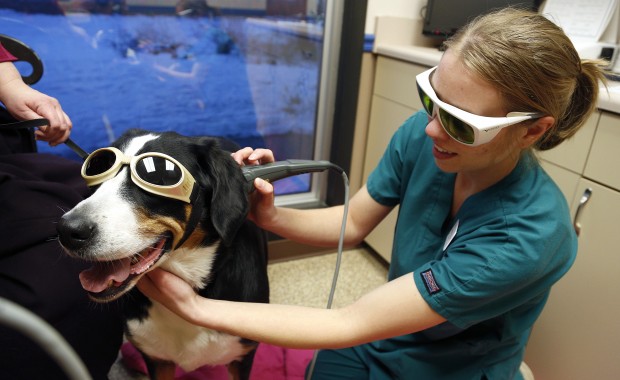
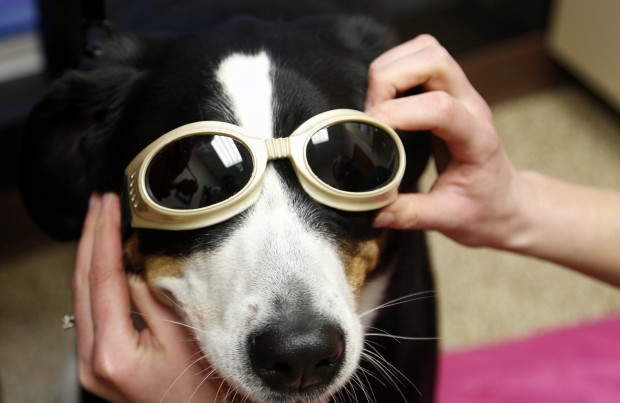
Boomer is taken to a treatment room where registered technician Katie Sebetka administers laser blasts to certain points around the dog's neck. Boomer stands calmly throughout the 10-minute procedure, wearing "doggles" to protect her eyes. This is her sixth treatment.
Not everyone is ready to accept alternative methods of treatment, Kneeland said.
"You have some people who are hesitant," he said. "You have the outliers on both sides," he said. "Some want only conventional and no alternative, and others want only alternative and no conventional.
"But I'm seeing less and less who only want conventional," he said. "I can't remember the last person who turned down holistic treatment. Most are willing to marry alternative and conventional treatments and enjoy the synergistic effects."
In the long run, the costs of alternative and conventional treatments are comparable, he said.
Kneeland said alternative treatments work better on some animals than others.
"It's not perfect," he said. "If a disease has progressed so far, all we can do is palliative care, make the animal feel better."
For Boomer, laser therapy has considerably improved her condition.
"She was running around and playing after the first week of treatment," Kneeland said.
In this article we are told, therefore, the efficiency that these procedures, which most of us may never have raised or their existence. It's really when you have a problem like this, or better said, a sick pet to which you want as a member of the family, when one reconsiders the use of these treatments, because if it agrees to perform them on one same, why not on an animal that is part of your heart and you want to cure every possible way?
"I could see a difference after two treatments, and she's gotten better since," said Stainbrook. "She's much more playful. It's like having my dog back."


COMENT 


We find ourselves before an article published in WCF COURIER's web page on 12th January 2013 that is about the alternative medicine treatments performed in pets.

Veterinary medicine is applying alternative methods of diagnosis and cure of diseases.

010813mp-alternative-medicine-pets-2It's pure logic to realize that if these treatments work in people may also may be useful in animals, so this initiative is becoming very popular in many places. These types of treatments that help both people and animals are increasing their demand due to many advances in alternative sciences (although they are closely related to medicine convencioanal have been detached much in recent years).


Although this may also be the reason that many still do not dare to use innovative techniques on their pets. There are opinions for all tastes. here is no medicine better than others, just each has a different way of diagnosis and treatment. Each medicine sees disease, diagnosis and healing from a different angle. Although it is true that depending on the different cases of problems and pets, there are more or less complicated solutions and effective.

This helps us understand who each have their advantages and limitations. We conclude that each time we decide what is best for our animal, a drug or another or a combination of several.


domingo, 3 de febrero de 2013

¿Sabes qué es la ginecología natural?

Cuando algo no funciona bien en nuestro organismo solemos visitar al médico, práctica importante en lo que refiere a la salud íntima de las mujeres. Sin embargo, existen alternativas a esta práctica: la ginecología natural.
Conocer las señales de nuestro cuerpo y saber cómo funciona es lo que muestra el “Manual introductorio de Ginecología Natural” y “Del Cuerpo a las Raíces”, cuya autora es Pabla Pérez San Martín, de tan sólo 25 años.
“El primero es un llamado a conocer nuestro cuerpo, escucharlo y sentirlo, para saber qué es lo que padece. Además, se ofrecen alternativas a los productos farmaceúticos”, dijo Pérez. “El segundo libro muestra el uso de diferentes plantas medicinales para la salud sexual y reproductiva”, agregó.
Pabla vive en Quilpué junto a su hijo y ambos son vegetarianos. “Con el tiempo me he dado cuenta que este estilo de vida me ha reportado muchos beneficios” señaló.
Pérez relató cómo se inició en esta aventura y cómo un viaje por Latinoamérica le cambió la vida. “Yo estudiaba sociología y me centraba en el feminismo. Después fui a viajar durante dos años por toda América Latina, donde pude convivir con mujeres de comunidades indígenas, desde donde recopilé todas estas recetas”.
Con respecto al escepticismo de ciertas personas hacia la medicina natural, Pabla aseguró que estos métodos existían hace muchos años, tiempo que los avala. “No sólo que reportan beneficios a la salud, si no que son más económicos y una buena opción para el medio ambiente”, acotó.
Como opciones a las tradicionales toallitas y tampones desechables, la joven escritora aconsejó el uso de toallas lavables o la copa menstrual. “Los métodos usuales tienen componentes que son nocivos para la salud de nuestro sexo. Si quieren mas información la pueden encontrar en www.ginecologianatural.org”, finalizó.

Comentario.
Esta noticia se publicó el 28 de enero de 2013 en la página Biobiochile y fue escrita por Nadia Flores.
En esta noticia se nombran algunas métodos útiles para las mujeres y se menciona el vegetarianismo. El vegetarianismo consiste en una dieta basada en productos que no provengan de animales, ya sean productos cárnicos, huevos, pescado o incluso queso. Esta dieta constituye un tipo de medicina alternativa puesto que muchas de las personas que la practican afirman que lo hacen para sentirse mejor con ellos mismo, tanto espiritual como físicamente. Sin embargo, no debemos olvidar que estas dietas deben estar reguladas por un médico o nutricionista ya que las personas que la toman dejan de consumir muchas de las proteínas que nos proporcionan los productos procedentes de animales. Recientemente se descubrieron unas algas de las que se afirmaba que proporcionaban muchas de las proteínas que son deficitarias en los vegetarianos. Sin embargo, todavía se está investigando.
La respuesta que se da en la noticia a los escépticos acerca de los métodos tradicionales es que se han usado desde hace mucho tiempo y no han cambiado. Esta no parece una buena escusa puesto que si la aplicásemos en todos los temas de la vidas diaria no existiría el progreso y la evolución. Por ejemplo, la máquina de escribir se ha usado toda la vida y funciona correctamente, pero, ¿debemos por ello dejar de usar los ordenadores? La respuesta es no. Si se usan toallitas y tampones desechables es por su comodidad e higiene. Puede que con estos métodos tradicionales se obtengan resultados similares pero nunca serán los mismos.

Meditation Combined With Art Therapy Can Change Your Brain and Lower Anxiety

Cancer and stress go hand-in-hand, and high stress levels can lead to poorer health outcomes in cancer patients. The Jefferson-Myrna Brind Center of Integrative Medicine combined creative art therapy with a Mindfulness-based Stress Reduction (MBSR) program for women with breast cancer and showed changes in brain activity associated with lower stress and anxiety after the eight-week program. Their new study appears in the December issue of the journal Stress and Health.

Daniel Monti, MD, director of the Jefferson-Myrna Brind Center of Integrative Medicine and lead author on the study, and colleagues have previously published on the success of Mindfulness-based Art Therapy (MBAT) at helping cancer patients lower stress levels and improve quality of life.

"Our goal was to observe possible mechanisms for the observed psychosocial effects of MBAT by evaluating the cerebral blood flow (CBF) changes associated with an MBAT intervention in comparison with a control of equal time and attention," says Monti. "This type of expressive art and meditation program has never before been studied for physiological impact and the correlation of that impact to improvements in stress and anxiety."

Eighteen patients were randomly assigned to the MBAT program or an education program control group. All had received the diagnosis of breast cancer between six months and three years prior to enrollment and were not in active treatment. The MBAT group consisted of the MBSR curriculum (awareness of breathing, awareness of emotion, mindful yoga, walking, eating and listening), paired with expressive art tasks to provide opportunities for self-expression, facilitate coping strategies, improve self-regulation, and provide a way for participants to express emotional information in a personally meaningful manner.

Patient response to the MBAT program was measured using a 90-item symptom checklist, completed by each patient before and after the eight-week program. In addition, functional magnetic resonance imaging (fMRI) was used pre and post-program to evaluate cerebral blood flow, corresponding to changes in the brain's activity. Scans were performed at rest, during a "neutral task" (control), meditation task, stressor task and at rest again -- designed to evaluate the general as well as specific effects and provide a thorough analysis of the CBF changes between the pre and post-program scans.

Participants in the MBAT group demonstrated significant effects on cerebral blood flow compared with the control group. The MBAT group showed increases in the emotional centers of the brain including the left insula which helps us to perceive our emotions, the amygdala which helps us experience stress, the hippocampus that regulates stress responses, and the caudate nucleus that is part of our brain's reward system. These increases correlated significantly with a lowering of stress and anxiety, as also reflected in the results of the pre and post-program anxiety scores among the MBAT intervention group.

The observed psychological and neuropsychological changes are consistent with current literature that states that MBSR interventions have shown to reduce anxiety, depression and psychological distress in a variety of populations. These have been associated with improved immune function, quality of life and coping effectiveness in women with breast cancer.

Given the improvements in anxiety levels and observed changes in CBF in the MBAT participants, these findings suggest that the MBAT program helps mediate emotional responses in women with breast cancer. "With the sample size enlarged, perhaps we can extrapolate these results to other disease populations and gain a fuller understanding of the physiological mechanisms by which mindfulness practices confer psychological benefits," says Monti. 


Coment
This piece of news was published  on 28th November, 2012 in the webpage Science Daily. It was written by Elisabeth J.S. 
Stress is in the origin of many diseases, both mental and phisical. The problem is that stress can't be healed by using drugs, it is need a change in the daily rutine of the person who suffers from it. It has many causes, for example the school or job, the family situation, economic situation...
In this piece of news it is mentioned that stress can cause one of the most serious disease, cancer. In order to avoid the appearance of this illness, the news mentions a method to reduce the stress, the MABT, which means Mindfulness-based Art Therapy and it has been proved that it really reduces the stress. 
This method can be very useful, not only to avoid cancer, but becuase there are million of people who suffer from stress and this could let them live their lives with normality.

Drinking Green Tea With Starchy Food May Help Lower Blood Sugar Spikes


An ingredient in green tea that helps reduce blood sugar spikes in mice may lead to new diet strategies for people, according to Penn State food scientists.
Mice fed an antioxidant found in green tea -- epigallocatechin-3-gallate, or EGCG -- and corn starch had a significant reduction in increase in their blood sugar -- blood glucose -- levels compared to mice that were not fed the compound, according to Joshua Lambert, assistant professor of food science in agricultural sciences.
"The spike in blood glucose level is about 50 percent lower than the increase in the blood glucose level of mice that were not fed EGCG," Lambert said.
The dose of EGCG fed to the mice was equivalent to about one and a half cups of green tea for a human.
Lambert, who worked with Sarah C. Forester, postdoctoral fellow, and Yeyi Gu, graduate student, both in food science, said EGCG was most effective when the compound was fed to the mice simultaneously with corn starch. For humans, this may mean that green tea could help them control the typical blood sugar increases that are brought on when they eat starchy foods, like breads and bagels that are often a part of typical breakfasts.
"If what you are eating with your tea has starch in it then you might see that beneficial effect," Lambert said. "So, for example, if you have green tea with your bagel for breakfast, it may reduce the spike in blood glucose levels that you would normally get from that food."
The EGCG had no significant effect on blood sugar spikes in mice that were fed glucose or maltose, according to the researchers who released their findings in the online version ofMolecular Nutrition and Food Research. Lambert said that the reason blood sugar spikes are reduced when the mice ate starch, but not these sugars, may be related to the way the body converts starch into sugar.
An enzyme called alpha-amylase that is produced in both the mouth and by the pancreas helps break down starch into maltose and glucose. EGCG may inhibit the enzymes ability to break down the starch, the researchers indicated, since they also found that EGCG reduced the activity of alpha amylase in the pancreas by 34 percent.
If the mechanism holds in humans, this may mean that people who want to limit the blood sugar spike should skip adding sugar to their cup of green tea.
"That may mean that if you add sugar into your green tea, that might negate the effect that the green tea will have on limiting the rise in blood glucose level," Lambert said.
Lambert added that the green tea and the starch would need to be consumed simultaneously. For example, drinking a cup of tea well after eating a piece of toast would probably not change the blood sugar spike.
For the study, researchers separated mice into several groups based on body weight. After a fasting period, the mice were given common corn starch, maltose, or sucrose. One group of mice received EGCG along with the feed, while a control group was not fed the compound.
The researchers then tested the blood sugar levels of both groups.
Lambert said the researchers next step is to test the compound on people.
"The relatively low effective dose of EGCG makes a compelling case for studies in human subjects," the researchers said.

Coment
This new was published on 9 November, 2012, in the webpage Science Daily, and was written by Sarah C. Forester.
Blood sugar spikes is a problem that afects to many people, it is known as hyperglycemia. It  is a condition in which an excessive amount of glucose circulates in the blood plasma. This is generally a glucose level higher than 11.1 mmol/l. Reference ranges for blood tests are 11.1 mmol/l, but symptoms may not start to become noticeable until even higher values such as 250–300 mg/dl or 15–20  mmol/l. A subject with a consistent range between 100 and 126 (American Diabetes Association guidelines) is considered hyperglycemic, while above 126 mg/dl or 7 mmol/l is generally held to have diabetes. Chronic levels exceeding 7 mmol/l can produce organ damage. Generally, excess blood sugar can be caused by:
  • not taking medications for diabetes when they should take or not take the proper amount.
  • not follow the meal plan for diabetes (such as overeating at a special occasion without adjusting for diabetes drugs)
  • not exercising enough
  • have a disease, like the flu, or being stressed
  • take other drugs which affect the effects of diabetes medications.
The signs of the hyperglycemia are: urinating a lot, drinking a lot, weight loss and tiredness
This new proposes this new treatmen, which can be an alternative to the insuline or can help people whit starting diabetes.


sábado, 2 de febrero de 2013

Some Alternative Therapies Work for Arthritis


Four treatments get a thumbs-up while acupuncture scores highest marks.

2/1/13

 There isn’t much scientific proof that complementary and alternative medicine (CAM) – from aromatherapy to reflexology – helps with the pain and disability associated with rheumatoid arthritis (RA), osteoarthritis (OA), fibromyalgia and low back pain. But based on the available evidence, researchers in the United Kingdom, who evaluated clinical studies on 21 CAM therapies for the four conditions, concluded that acupuncture, massage, yoga and tai chi work in some cases.

These findings don’t mean that other CAM therapies – defined by this report as any therapy that exists outside normal health care practices – aren’t effective. The researchers stress that, in many cases, there just weren’t enough high-quality data to fully evaluate the therapies. “Where there is no or little evidence, it is very difficult to judge,” says lead author of the report, Gareth Jones, PhD, a senior lecturer in epidemiology in the School of Medicine and Dentistry at the University of Aberdeen in Scotland.

The report is one of two published recently by Arthritis Research UK, a large medical-research organization. The other report rated supplements in the treatment of OA, RA and fibromyalgia.

To evaluate CAM treatments, the researchers used a five-point scale to judge the effectiveness of each. A ranking of 1 indicates little to no evidence of efficacy; 5 means there is consistent evidence from high-quality trials that a therapy improved patients’ pain, disability and quality of life.

Researchers also rated treatments’ safety profiles, using green for safe, red for unsafe and amber for somewhere in between.

Overall, acupuncture got high marks for helping in OA, low back pain and fibromyalgia. Massage was deemed effective for fibromyalgia and low back pain. Tai chi helped OA, and yoga was effective for low back pain.

Other CAM therapies that were evaluated – but came up short – included aromatherapy, autogenic training, biofeedback, copper bracelets, craniosacral therapy, healing therapies, hypnotherapy, imagery, magnet therapy, meditation, music therapy, qigong and reflexology.

Here are more details on the findings.

Rheumatoid Arthritis

A review of 24 trials testing nine therapies on slightly more than 1,500 patients found no treatment worked or had enough evidence to support efficacy among those with RA. The highest scores given in this category were a 2 on the 5-point scale – indicating a little evidence – for biofeedback, relaxation therapy and tai chi.

Daniel J. Clauw, MD, a professor of medicine in the division of rheumatology at the University of Michigan in Ann Arbor, says the message to RA patients is: Don’t use CAM therapies instead of conventional treatments, because there are very effective medications on the market to treat RA pain and aggressively address damage to joints. “You could be doing more than wasting time and money while dabbling with CAM therapies if you aren’t also making sure the inflammation is being well controlled,” Dr. Clauw says.


COMENT 


This report published in Arthritis Today magazine by Arthritis Foundation on 1st February 2013 is about a research on different types of alternative treatments and their effectiveness.

Today there are, as we have mentioned from the beginning of our blog,  lots of alternative and novel treatments  of which we know neither half, let alone its realization process, effectiveness, side effects, potential benefits , etc.


So we have a text that shows, in contrast to other previously published entries, that there is not much research done on the subject, and in the meantime we can only rely on the experience of each. "Where there is no or little evidence, it is very difficult to judge”.

It is possible that some of these therapies may be helpful for some people, and they are not the same for others. "I am myself and my circumstances", as Ortega said. Each person is different, and generalizations are impossible.